


Fort Kochi - Maria de Vries
Beneath a nowadays virtually illegible gravestone in the St. Francis Church in Cochin, Maria de Vries was once buried with her sons Johannes, Josias, and Gerardus. Maria, according to the inscription, lived to be only 21 years old and was reunited in the grave on 23 August 1679 with her son Johannes, who had already died on 26 July 1673. A quick calculation shows that Maria was only 15 years old when Johannes died at the age of one. She was therefore 14 years old at his birth. By Dutch standards, this was extremely young.
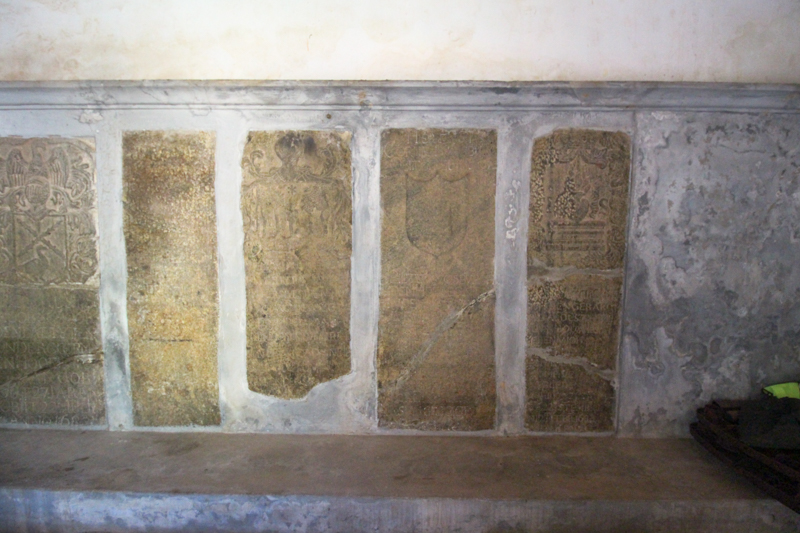 Wall with tombstones. To the right, the tombstone of Maria de Vries
In the seventeenth century, Dutch women were on average 20 years old and men 25 at their first marriage. The age at which girls married in the VOC territory was generally much lower, and this custom was soon adopted by the European newcomers to the area. In the case of Maria and Johannes Spiljardus, Johannes, barely 20 years old, was also still young. It is not inconceivable that the marriage was a ‘must’ wedding (aka a shotgun wedding). Johannes was left behind with their sons, Gerardus, aged four, and Josias, aged five, after Maria’s death. However, they would soon be buried with their mother on 22 September 1683, aged 8, and 12 February 1683, aged 7, respectively.
Little is known about Maria and her children. The VOC archive is a corporate archive in which little attention was paid to family, unless something occurred that affected the functioning of a staff member. In this case, that was the functioning, or rather the non-functioning, of Marcus Masius, the minister of St. Francis Church. Rev. Masius was known as an uncomfortable, hot-tempered man who alienated many people. During his career within the VOC, he had already preached the word of God at several trading posts, such as in Formosa, Japan, Ambon, Ceylon, and finally in Cochin. The complaints against him mounted up, and the situation became untenable. European men who did not have an ‘Act of Indemnity’[1] that they had brought with them from the church of which they had previously been members were refused by him to become members of the church in Cochin. He did not want to minister to Lutherans, and according to the notes that have been preserved regarding this, he did not want to admit Johannes Spiljardus, the son of a minister, to communion because of, in his eyes, the “offensive behavior of his mother.”[2] Maria was not welcome either, even though she had made her confession at a young age. He found her too young, incompetent; she was quiet, had little social interaction, did not show him the respect due to him, was not modest enough, and was moody.[3] Reverend Johannes Ceasarius stood up for his congregation and openly attacked Masius. Masius was removed from office, and peace was restored.
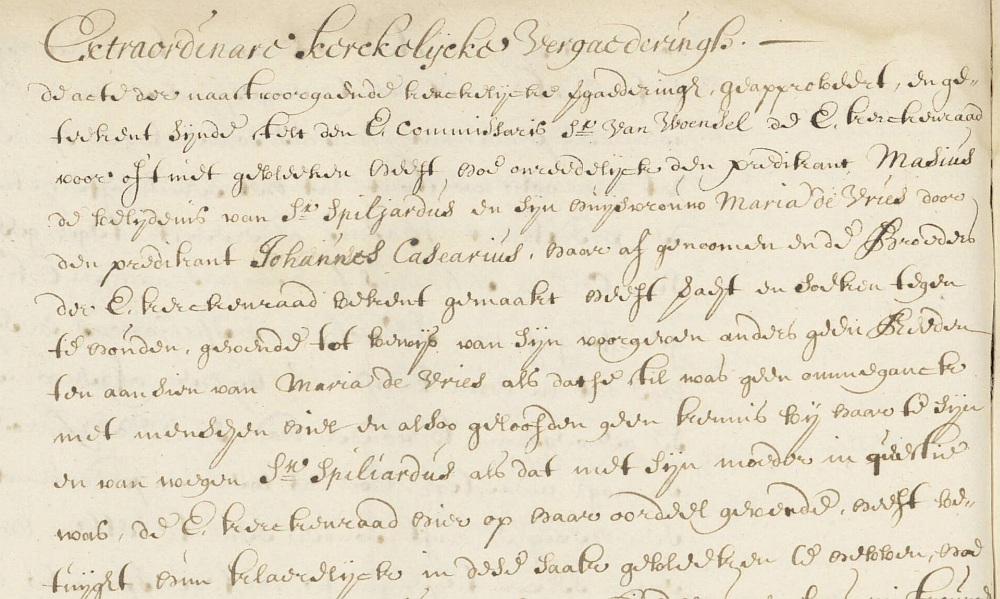 Complaints on Rev. Masius (NL HaNA 1.04.02 1308 1516)
The question of who Maria’s parents were, is not easy to answer. Johannes and Josias were names from the Spiljardus family. Gerardus could be the name of Maria’s father. She was considered a European woman, so her father and mother must have been of European descent. The surname De Vries is the most common surname in the Netherlands, but the VOC accountants quite often Dutchified the surnames of foreigners. A Gerardus de Vries was not found in the records, but a Lieutenant Gerrit Jansz de Vries van Oldenburg who served in Cochin was.[4] Together with two other lieutenants, on 22 March 1665, he received a deed of grant for a house and plot of land in the Rechtestraat in block J. Gerrit received the house numbered 3 .[5] He died there on 4 August 1670.[6] According to a transcription of his unrecovered gravestone, he would have been 30 years old at the time of his death. A report from the VOC states that he had faithfully served the VOC for many years. Since a lieutenant's position was often not attained until around the age of 35, it is theoretically possible that the transcription of his stone contains an incorrect age.
It is certain that a ‘Juffr. the Widow’ De Vries also lived in Cochin, a Dutch woman. She plays a role in three families, one of whose partners has Cornelia de Leeuw as a mother.
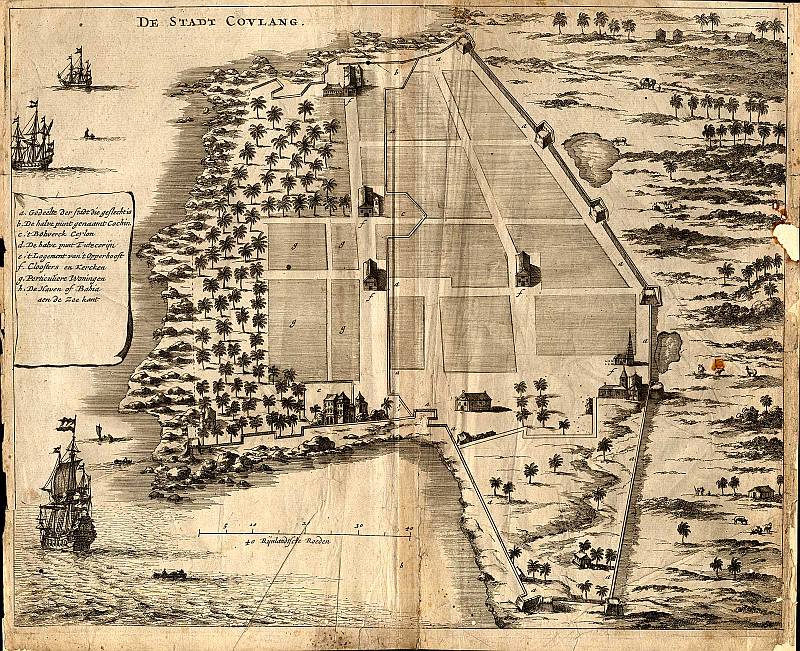 Coyland, map 1672, by Philip Baldaeus.
In 1685, a register of households on Malabar was compiled.[7]Johannes Spiljardus is then the Opperhoofd of Coylang and lives there with his sizable family. He has remarried and lives with his wife, a young son, twelve male and female slaves, and two child slaves. Living with him are Mrs. (widow) Vette with two sons, her four male and female slaves, a slave child, and two sons of Boevius. A total of 27 persons. ‘Juffr. the Widow’ Vette's maiden name is Catharina Moring. She is the half-sister of Johannes Spiljardus.[8] Her two sons are Isaac Vette, born around 1674, and Pieter Vette, born around 1675. The two Boevius sons are children of Elisabeth Moring, another half-sister, and her husband, chief merchant Marcelis Boevius.[9] The couple has since passed away and left behind three sons. Johannes Spiljardus is their legal guardian. The third son of the Boevius-Moring couple lives with Mrs. (widow) de Vries in Cochin.
In 1686, in the household records, Spiljardus's young son was no longer alive, and his half-sister Catharina, together with her children, the Boevius children, and her slaves, had moved in with Mrs. (widow) de Vries in Cochin.[10] On 31 December 1690, when the records were drawn up again, Miss Parmentier, widow, formed a household together with the widow de Vries. Once again, the widow Jacob Parmentier appears to be identical to Catharina Moring, who has had a short-lived marriage for the fourth time and is now living again with her two sons and two stepdaughters with the widow De Vries, whose actual family name simply refuses to surface.[11]Does the name of Mrs. (widow) de Vries conceal Maria's mother/stepmother, or is it (given the involvement with Cornelia de Leeuw's children) Widow Spiljardus rather Widow Moring? For the time being, the answer remains shrouded in mystery.
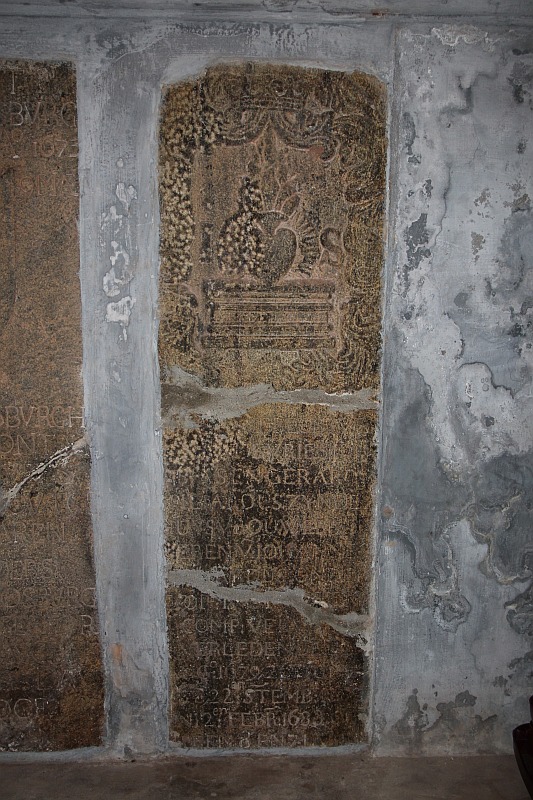 Tombstone of Maria de Vries.
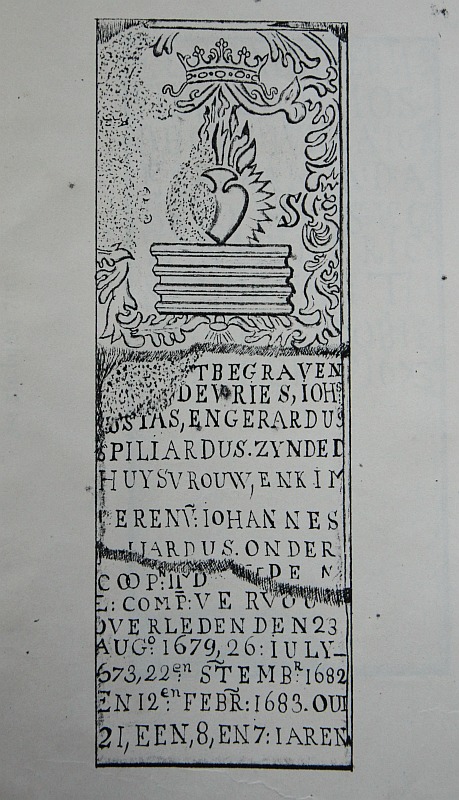 Transcript tombstone Maria de Vries.
Johannes Spiljardus's life was not a bed of roses. He was baptised in Haaften on 21 August 1653, as the son of Josias Spiljardus and Cornelia de Leeuw, lived in Gorinchem between 1655 and 1660, and then left with his mother, younger brother, and a half-sister for Ambon, where his father was a minister.[12] He entered the service of the VOC in 1666 and spent most of his time on the coast of Malabar, where he slowly but surely climbed the social ladder. After numerous administrative positions, he became a junior merchant in 1676. From March 1681 to April 1682, he was Opperhoofd of Coylang, after which he left for Batavia. In March 1685, he became Opperhoofd of Coylang for the second time, but was suspended from duties in August 1686 due to prohibition of the trade in slaves, among other things. He was reinstated in his position in 1691, but in September 1693 was permanently dismissed.[13] He had seen this coming, for in 1692 he himself had already requested permission to repatriate to the Netherlands. This was refused, but he was allowed to come to Batavia with his family to account for himself. Spiljardus, in turn, refused this, as he considered it irresponsible to go to Batavia with a newborn, unbaptised baby.[14] But there was no escaping it, and the family was put on a ship bound for Batavia. No documents have survived revealing exactly what he was accused of, but it was sufficient to send him back to Cochin, separated from his family, in order to settle his affairs. His mental health had not improved over the years. The documents repeatedly mention that he had to be guarded and locked up for weeks on end because he walked through the city raging, screaming, and threatening.[15] He repeatedly asked to be allowed to join his wife in Batavia, but this was consistently refused. In 1698, he was still living alone with a slave and was incapable of doing anything.[16] Eventually, he was allowed, under the supervision of his cousin Adriaan Boevius, to leave for Batavia on the Oosthuijsen in 1698.[17] In September 1699, completely lost, he was confined to the poorhouse by order of the authorities and placed under guardianship. The last document in which his name is mentioned dates from 1740, when the Orphanage of Batavia objected to being asked to pay out his inheritance.[18]
Notes
[1]A certificate of proof as a member of a church that would also assume the costs of any maintenance expenses in the event of decline into poverty
[2]See about Cornelia de Leeuw https://www.wiedenis.nl/gorinchem-en-de-voc/josias-spiljardus-predikant-in-de-oost/
[3] NL-HaNA_1.04.02.1308
[4]Oldenburg is a city in the German state of Nedersaksen.
[5]NL-HaNA_1.11.06.11.3 _0003 The other lieutenants were Uytter Burghart, he received no. 9, and Barent Harmensz received no. 1
[6] This stone still lay in 1946 in the St. Francis Church. List of inscriptions on tombs or monuments in Madras by Julian James Cotton, c.s. revised edition in two volumes, Volume II, Madras 1946.
[7] NL-HaNA_1.04.02.1410
[8]Catharina Morings is the daughter of Rev. Isaacus Moring and Cornelia de Leeuw. She was baptised on 9-10-1642, married 1st Crijn Cant, VOC skipper, 2nd r 1667 Jan Evertse van Es, VOC skipper, from this marriage a daughter Anna, 3rd Vincent Vette VOC bookkeeper at Nagasaki (1657), free merchant in Batavia, 4thJacobus Parmentier. She was still living in Cochin in 1699.
[9]Elisabeth Moring is the daughter of Rev. Isaacus Moring and Cornelia de Leeuw. She was baptised on 9 August 1640, in Haaften. She married Marcelis de Boeff van Gorcum in Delft on 2 November, 1658. Marcelis was the son of Adriaen Hendriksz de Boeff and Jenneke Marcelis van Antwerpen. From this marriage were born: Isaac (1659), Isaac (1660), Adriaen (Batavia), Marcelis (Cochin), and Anthony (Cochin). They departed on 9 January, 1662, aboard the Venenburg of the Amsterdam chamber. He left as a bookkeeper and died as chief of Coylang on 10 March 1681 (Batavia Daily Register 1681).
[10] NL-HaNA_1.04.02.1425_0269
[11] NL-HaNA-1.04.02.1474_0972
[12]See https://www.wiedenis.nl/gorinchem-en-de-voc/josias-spiljardus-predikant-in-de-oost/
[13] NL-HaNA_1.04.02_1762_1286
[14] NL-HaNA_1.04.02.1528_0019
[15] NL-HaNA_1.04.02. 1527_0385
[16]NL-HaNA_1.11.06.11.2A_0156
[17] NL-HaNA_1.04.02.1604A_0206
[18] NL-HaNA_1.04.02.2485_0507
- Last updated on .