


Fort Kochi - Jacob Schoors
In May 1673, two VOC ships were scheduled to depart from Vlissingen, so the drum was beaten to announce that personnel were needed. On 20 April 1673, Jacobus Schoor, 18 years old, came to apply for a position at the VOC (Dutch - Verenigde Oostindische Compagnie, or the United East India Company) office in Middelburg and was hired as an assistant on the ship "de Bergeend" (Dutch for ‘shelduck’), with a salary of 24 guilders per month.[1]
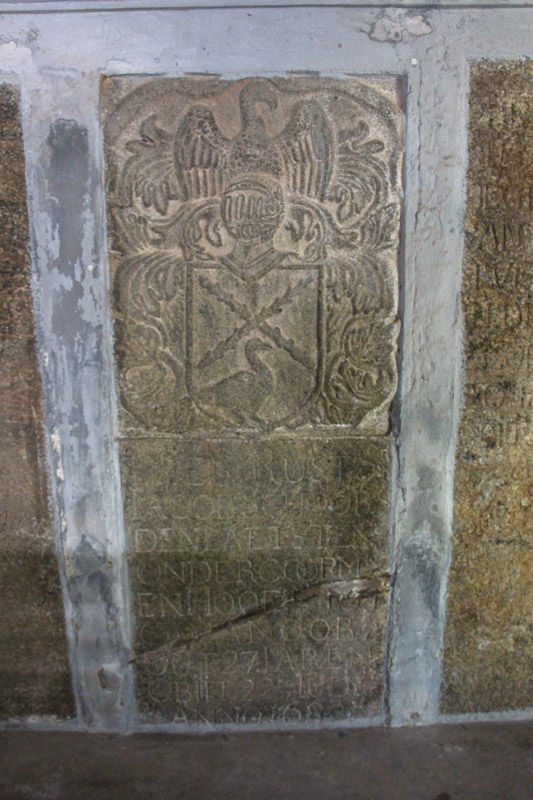 Tombstone of Jacob Schoors, in the wall of the church (photo René ten Dam, 2020).
The Bergeend was a Dutch hooker (a small fishing and transport vessel), designed for fishing, and due to its size of 24 metres long and 6 metres wide, could be operated with a small crew of 23 people. Jacob had to do the paperwork and bookkeeping of pay ledgers while en route. The Bergeend departed Vlissingen on 26 May 1673 and arrived in Ceylon in February 1674. There, it was decided that Jacob would be posted to Tuticorin as a bookkeeper. He quickly attracted attention for the skill with which he carried out his work, and on 7 December 1678, he was sent on the ship Windhond (Greyhound) to buy cardamom in Cannanoor. But once underway, he was appointed deputy chief of Cannanoor, present-day Kannur, on 20 December 1678. He was also immediately promoted to deputy sub-merchant.[1]
Cannanoor was particularly important for the trade in spices such as pepper, cardamom, and cinnamon. Jacob Schoors managed to strengthen ties with local rulers, such as with the cartoen (regent) of Dermapatnam and with the successor of the former queen of Cannanoor, King Collatry, "a fixed, sure, and binding contract of peace and eternal covenant, or as long as sun and moon shall exist," as was recorded in his palace in Baliepatnam on the 23rd day of Burtchigram (3 December 1680).[2] When it turned out that Jacob had also managed to significantly increase the trading post's profits, the governor of Cochin decided to grant him the permanent rank of sub-merchant, as well as award him the corresponding salary retroactively. It must have been a handsome reward for Jacob.
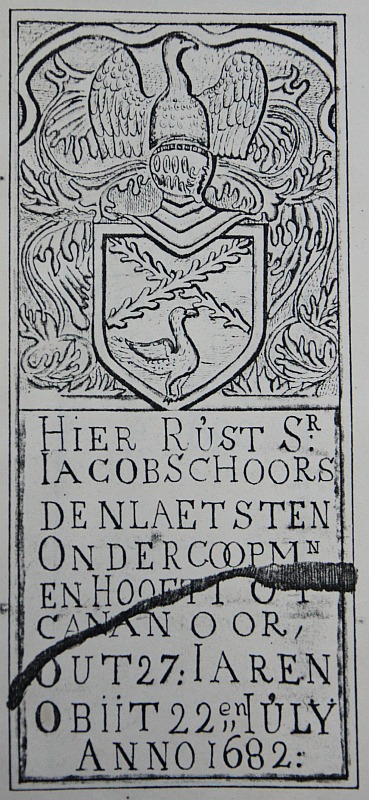 Drawing of the tombstone of Jacob Schoors
Not everything went smoothly. For example, on 8 April 1680, the ship Baijpin, on which Jacob van Cochin was returning to Cannanoor, was attacked by Moors. After encouraging words to the crew that they had to be brave and help each other, they were provided with as many weapons and firearms as possible. The five cannons on board were loaded and fired. Jacob immediately ordered the cannons to be reloaded, but the enemy had already come too close, and the force of the firing caused the cannons to fall from their mounts. Jacob was already firing at the enemy with a musket and gave orders to reload the cannons, but some of the crew had fled into the cabin. From a second ship with Moors, stones, arrows, lances, and fire pots were thrown at the Baijpin, and a fire started. Jacob, meanwhile, had been wounded in both cheeks, and he had no choice but to retreat to the cabin, where he tried to pull open the door to call the crew to order and warn them of the fire. He found them behind a locked door, " where they altogether stood like sheep upon one another." He called out to them to come and help, but they refused because they were insufficiently armed and could only fire at the enemy through the cabin's portholes with the few muskets they had. When the Moors realised the crew was in the cabin, they cut it open and threw baskets of burning kapok inside. Eventually, the crew was captured and thrown overboard into their vessels. Their captivity did not last long, as a statement about the incident was issued on April 28th. Unfortunately, it is unknown how they were released.[1]
In March 1682, Jacob requested permission to come to Cochin for a few months. Pieter van de Kouter could replace him as chief of Cannanoor for that period. On 25 April 1682, Jacob was able to leave for Cochin. He was now 27 years old and, as far as we know, unmarried. Did he want to go to Cochin to find a wife? We will never know. On 22 July 1682, he died in Cochin and was buried with due honors in St. Francis Church.
Notes
[1] NA 1.04.02.7250_0006
[1] NA 1.04.02.1360_0822
[2] CORPUS DIPLOMATICUM NEERLANDO-INDICUM. Third part, Dr. F.W. Stapel.
[1] NA 1.04.02_1361_1111
- Last updated on .