


Pulicat - Adriana Geerits Cant (± 1610-1657)
A world traveler from Werkendam
On a very hot day in February 2024, we step out of the air-conditioned car. Not only the heat overwhelms us, but also the surroundings and the smell of fish. We are standing in a filthy square where the fish market is winding down and where even the breeze from the Bay of Bengal offers no relief. We are making a journey through the two southern states of India, Tamil Nadu and Kerala, past the heritage of the Dutch East India Company (VOC).
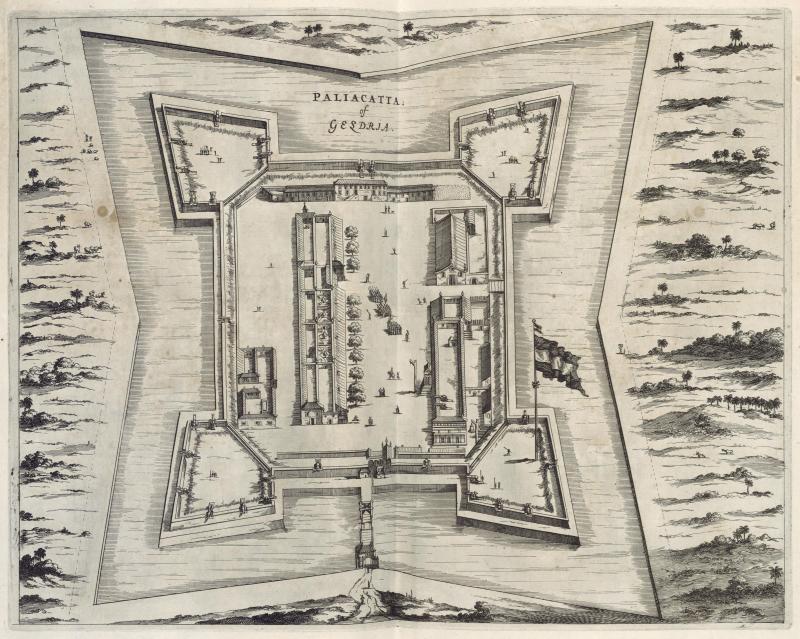 Fort Gelria (Atlas of Mutual Heritage)
Precisely on this spot once stood Fort Gelria, the headquarters of the VOC on the Coromandel Coast, where ships sailed in and out to trade primarily in gunpowder and textiles. The cotton clothing was purchased in the surrounding villages and was used to buy spices in the Indonesian archipelago. Within the gates of the fort, there were living quarters for approximately 85 men, consisting of merchants, some with their families, a minister, and soldiers, and there was a gunpowder factory. Twenty-six cannons were intended to protect the fort, or ‘castle’ as it was often called, against the enemy. The fort was occupied by the English in 1781 and razed to the ground in 1782 by Haider Ali, the Sultan of Mysore, who wanted nothing to do with the English. While we curiously take in the surroundings, we are viewed with even more curiosity by the men present. Our driver explains that we are looking for the Dutch cemetery. With their help, it is quickly found, and it also appears from the "manager" who rushed over that news spreads fast there.
Here in Pulicat, two cemeteries have been preserved where VOC employees were buried with their families. The cemetery that we are standing in front of now has been overgrown for a long time, but for several years now it has been managed by the Archaeological Survey of India and maintained by the local population by occasionally putting a few goats on it. In our eyes, somewhat unusual, but it works. Many headstones are still clearly legible and are all photographed while I explain to the accompanying caretakers what is inscribed on them. I linger longer at one of the grave monuments. It is a grave where several people are buried. The text differs from that on most of the other stones, but that is not the reason why I am standing here longer. I try to remember where I saw the couple's names before.
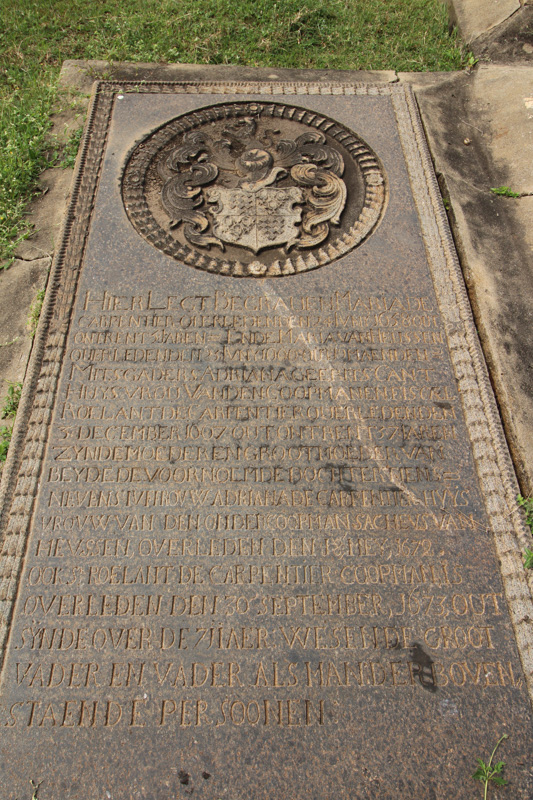 Tombstone Maria de Carpentier (photo René ten Dam, 2020)
“Hier legt begraven Maria de Carpentier overleden den 24 junij 1658 out ontrent 5 jaren=Ende Maria van Heussen overleden 23 junij 1666 out 19 maenden= mitsgaders Adriana Geerits Cant Huysvrou Vanden Coopman en Fiscael Roelant de Carpentier overl/den den 3 december 1667 out ontrent 57 jaren zijnde moeder en grootmoeder van beyde de voornoemde dochtertiens= Nevens juffrouw Adriana de Carpentier Huijs/vrouw van de ondercoopman Sacheus van Huessen, overleden den 18 mey 1672 Ook Sr. Roelant de Carpentier Coopman is overleden den 30 september 1673, out sijnde over de 71 jaer; wesende grootvader en vader als man der bovenstaende persoonen”.
In translation: “Here lies buried Maria de Carpentier, deceased on 24 June 1658, aged about 5 years = And Maria van Heussen, deceased 23 June 1666, aged 19 months = as well as Adriana Geerits Cant, wife of the merchant and fiscael Roelant de Carpentier, deceased on 3 December 1667, aged about 57 years, being mother and grandmother of both the aforementioned daughters = Next to Miss Adriana de Carpentier, wife of the junior merchant Sacheus van Huessen, deceased on 18 May 1672. Also Roelant de Carpentier, merchant, died on 30 September 1673, being over 71 years old; being grandfather and father as husband of the above-mentioned persons”.
It is something like a pebble in your shoe that keeps irritating you. I think they have “something” to do with Werkendam, but what? It will be at least another month before I can look at my computer, which is in Werkendam. When I get home, I will start looking.
On 12 April 1653, Roeland de Carpentier and Maria Gerrits Cant, a married couple “coming from Brazil,” were admitted as members of the church in Werkendam. That they also actually settled in Werkendam becomes apparent when their daughter Maria, born at 2:30 a.m. on 1 September, is baptised in the Werkendam church on 3 September. Unfortunately, sorrow soon follows when, six days later, on 9 September 1653, their 10-year-old daughter Helena is buried in the same church. There must be a reason for a family coming from Brazil to Werkendam. It must have been a conscious choice, and that cannot be something as simple as the availability of a home. Since the name De Carpentier does not appear here, while the surname Cant does, it is likely that Adriana Gerrits Cant was born in Werkendam.
The course of women’s lives in history is virtually invisible. Often, nothing more can be found than a birth or baptism date, a marriage and death date, and the number of children. Unfortunately, even that is not the case for Adriana Geerits Cant. When she was born can only be determined approximately from her epitaph. The very little we know about her we owe to her father-in-law, who recorded his life story and that of his children in writing, and which, miraculously enough, has been preserved.[i] With that information at hand and the necessary research in the archives, it proved possible to at least establish that she was an adventurous woman with bravery and perseverance.
The Cant family was present early in history in the area between Werkendam and Geertruidenberg. In 1514, a Gijsberth Cant was mentioned as a clergyman in Geertruidenberg and a landowner in the vicinity of present-day Dussen. As the sixteenth century progressed, the name also appeared in Rijswijk and Uppel, with the characteristic first names Floris and Ghijsbert. The family was generally prosperous and well-educated. Since no baptismal records from the region from that time have survived, Adriana's baptismal date is also unknown, but it must have been around 1610. Gerrit Floriszn Cant, who lived in Werkendam, is possibly her father.[ii] No children are known of him (yet), but he does mention grandchildren in his will.
These are turbulent times in the Netherlands. The Eighty Years' War has resumed following the expiration of the Twelve Years' Truce. The Northern Netherlands is flooded with refugees from the Southern Netherlands. The Dutch East India Company and the Dutch West India Company have been founded, luring many young people eager for adventure to distant shores. In particular, Brazil and the coast of North America in the vicinity of what is now Albany, attract colonists who see potential there. Brazil is especially popular due to the sugar plantations previously established there by the Portuguese, who had by then been driven out by the Dutch. Entire families set out in search of fortune and wealth. How Adriana Cant ended up in Brazil remains shrouded in mystery. She may have traveled with other family members, as several men with the surname Cant appear in Brazil during the same period.
The De Carpentier family had fled from the Southern Netherlands and ended up in the Northern Netherlands via England. The branch in which Roeland was born on 18 July 1603, settled in Dordrecht. Another branch of the family had settled in Amsterdam. From the Amsterdam branch, Pieter de Carpentier had left for the East Indies and, since the departure of Jan Pieterszoon Coen in March 1623, was the new Governor-General there. Johannes de Carpentier, Roeland's father, was a first cousin of Pieter. Roeland was one of his ten children with three women. Eventually, Johannes and nine of his children would go to live and work in Brazil.[iii] On 6 January 1626, Johannes wrote:“On 6 January 1625, my son Roelant sailed from Vlissingen to the East Indies on the ship Mauritius, of which 700 lasts, as a junior clerk; his wages were 22 guilders a month; there were 400 men on board, and he arrived in Batavia on 3 October 1625, where at that time our nephew Pieter de Carpentier, son of Pieter, was Governor and General of the East Indies. And on 17 July 1633, he arrived back from the East Indies in Texel.” Roeland did not stay in Dordrecht for long. His father noted “On 4 April 1634, my aforementioned son Roeland sailed from the Meuse to Brazil. He married Adriana Geerits on Recif in Brazil on 23 March 1639. They had nine children”.
Upon arriving in Brazil, Roeland received a license to trade in Brazilian hardwood. In 1639, the year he married Adriana Cant, he was registered as the owner of the Formoso sugar mill near the town of Serinhaém. Associated with the sugar mill were three tenant farms that had to deliver their sugarcane to the mill to be turned into sugar. The mill was powered by oxen and ground a hefty 47.000 kilos of sugarcane per year, yielding approximately 4.700 kilos of sugar. Serinhaém was only a small town with a limited European population consisting of a number of sugar mill owners and soldiers of the Dutch West India Company (WIC) who were married to Portuguese women. Coincidentally, Casper Velthuijsen from Gorinchem was a minister there. Life at the sugar mill was not without danger. The indigenous population went on raiding expeditions with some regularity, but over the years, the Portuguese also began to launch attacks with increasing frequency in the hope of recapturing the country. Roeland and Adriana's first child, Maria, was born on 18 September 1641, but died at the age of 10 months in Bahia, a city on the Bay of All Saints. The second daughter, Helena, was born on 10 February 1643, followed by Servaes on 13 August 1644, at the Engenho (sugar mill) Formoso. He was baptized on 21 August of the same year by Reverend Casparis Velthuysen.
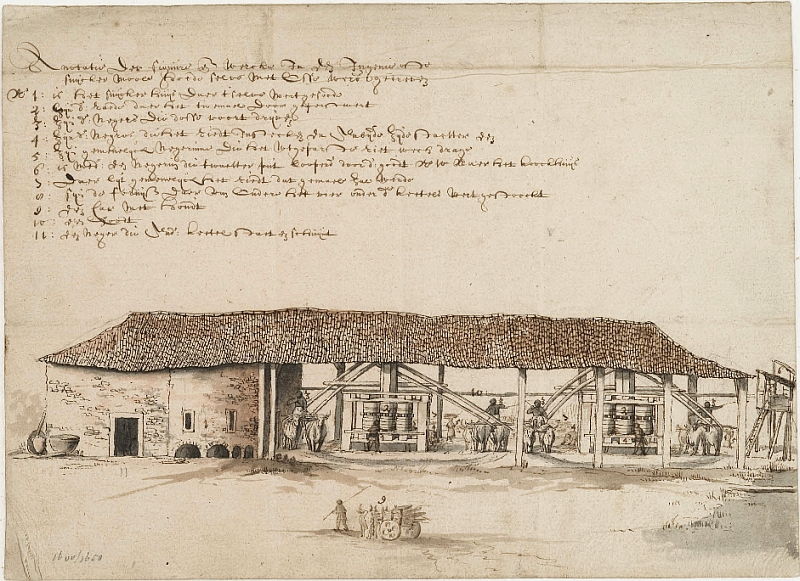 Sugar mills driven by oxen. Drawing by Frans Post (1612-1680) made in 1640 in the Dutch colony in Brazil.
On the night of 19 July, 1645, the sugar mill was raided by enemy raiders. First, they attempted to seize the sugar in the name of the King of Portugal. When De Carpentier refused to comply, a calf was plundered and slaughtered, and most of his Black servants and slaves, 37 in total, were carried away. Two horses and other small livestock were also taken. A number of the raiders were recognized, but the loot had already been divided and the raiders fled.[iv] Although Roeland had decided to accept Portuguese sovereignty, he was not allowed to continue living at the mill and was banished to Bahia. He entered into an agreement with a number of Portuguese-Brazilians who took the sugar mill and factory under their protection. In 1647, his sugar mill was plundered again. Eventually, he was dispossessed. Daughter Adriana was born on 26 October 1646, but died in Bahia at just over 5 months old. The next Adriana was born in Bahia on 24 March 1648, just like her brother Johannes on 6 October 1650. [v]
Meanwhile, the threat from the Portuguese had grown so great that reinforcements from the Republic arrived in March 1648 under the command of Witte de With. This led to the First Battle of Guararapes, where 2.300 Portuguese routed the 4.500 Dutch. To prevent further damage, the Dutch withdrew, but suffered approximately 500 dead and more than 550 wounded. In February 1649, the Dutch were lured into a trap by the Portuguese at the same location. The engagement ended in a flight of the Dutch soldiers, of whom 957 perished. The consequences of these defeats were also felt in the vicinity of Werkendam. From a city like Gorinchem alone, 27 men were killed. When the West India Company decided to relinquish its rights to Brazil in exchange for compensation, Roeland demanded a sum of 40.000 florins, partly on behalf of his now deceased brother Servaes. It is questionable whether they ever saw any money. Roeland and Adriana left Brazil and, together with their children Helena, Servaes, Adriana, and Johannes, sought their fortune in Werkendam.
The transition from sunny Brazil to the cool and wet Netherlands was a major one for the entire family. Roeland had been away from the Netherlands for more than 25 years, and the children knew it only from stories. Furthermore, they no longer had an income, and it is questionable whether they still had many possessions. Roeland had to look for work. He eventually found it at the VOC as a fiscaal, a kind of tax inspector. While they were still living in Werkendam, something remarkable happened. A book appeared about the recent history of the Dutch in Brazil, written by someone calling himself Lief Hebber (‘Enthusiast’). In it, he tells the story of how Roeland Carpentier, owner of the Formoso sugar mill, was accused of high treason and died by beheading after severe torture. Roeland probably never saw this story. The fact that Roeland was never found in Brazil may have led to this story being included in most publications about the Dutch in Brazil today. To this very day.
Roeland and Adriana departed with their children on 11 April 1656, aboard the ship de Parel (The Pearl) for Batavia. Roeland held an official position, while Adriana and the children were passengers. In total, there were three women and eight children on board. From Batavia, Roeland was sent on to Pullicat on the Coromandel Coast. Life there would not have been easy, but in return, they received board and lodging. Even if the family were to live outside the fortifications, there was usually an allowance in the form of, for example, candles, oil, drinks, and bread. Fortunately, people were very satisfied with Roeland’s work ethic, and in 1658 he was given the additional position of junior merchant. For all doubters as to whether we are still talking about one and the same Roeland, all doubt is now removed by the mention “He has also personally attended various exploits and military campaigns in Brazil, as a result of which we know of no more capable person to appoint as a merchant of greater respect.”.[vi] This is of particular importance because in the book In steen geschreven (Written in Stone) by Marion Peters, ‘our’ Roeland is confused with his cousin Roelant, son of Pieter de Carpentier and Maria de Witte, who is said to have led his life in Dordrecht.[vii]
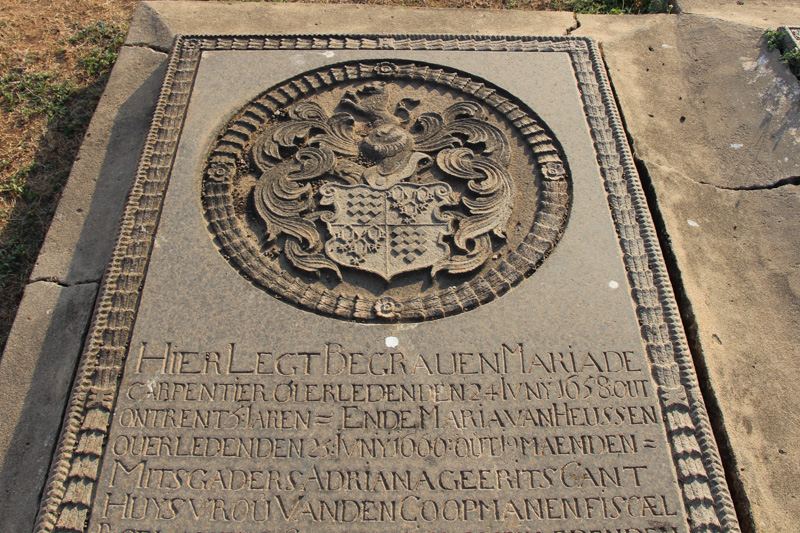 Detail tombstone Maria de Carpentier (photo René ten Dam, 2017)
Roeland was promoted to chief merchant, but in fact, the gravestone tells the story of the course of their subsequent lives. Maria, born in Werkendam, lived to be only 5 years old. Adriana lived to see her daughter and namesake, Adriana, aged 16, married the assistant Zacheus Heussen in 1664. Three generations of women, born on three different continents. Roeland outlived them, but felt himself growing old and weak, rendering him no longer able to climb into and onto the ships to inspect the cargo. He requested to be discharged from this duty, allowing him to function solely as a chief merchant. This was granted. On 30 September 1673, at the age of 70, he too died. The sons Servaes and Johannes remained living and working in India, where they would also die.
After a few hours, we bid a warm farewell to the men who maintain this cemetery so well. We are given one last small task: to let the King know back home that they are keeping his cemetery in good order.
Notes
[i] De Nederlandse Leeuw, jaargang 44 (1926)
[ii] With thanks to Remco van den Heuvel
[iii] Casper became a minister in Amsterdam, Amersfoort, and Sliedrecht.
[iv] NA OWIC inv. 60 scan 115/1
[v] Johannes states that Roelof and Adriana had nine children, but to date, seven children are known.
[vi] NA 1.04.02.1231_0283
[vii] Roelant de Carpentier (Dordrecht 31.12.1620-) son of Pieter and Maria de Witte
Translation by Erin White.
- Last updated on .